
The demoscene has long stood as a vibrant testament to the creative potential of constrained computing environments, where coders, artists, and musicians collaborate to push hardware to its absolute limits in pursuit of visual and auditory spectacle. From the earliest Amiga and PC experiments to today’s sophisticated real-time renderings, these productions blend technical wizardry with artistic vision, often under severe size or platform restrictions that would challenge even seasoned game developers.
What Makes a Great Demoscene Production?
A standout demoscene production balances raw technical achievement with compelling artistic execution, often within tight constraints like limited memory, processor cycles, or file size. Key elements include innovative procedural generation, custom shaders or effects routines, synchronized tracker music that drives the visuals, and seamless scene transitions that maintain immersion without relying on pre-rendered assets. Productions earn acclaim through originality—such as novel particle systems or raymarching techniques—combined with emotional resonance, whether through abstract narratives or homage to classic themes. Community judging at events like Assembly or The Party further elevates works that demonstrate mastery of specific platforms, from 8-bit C64 hardware to modern GPUs, while inspiring future creators with open-source code or detailed breakdowns.
Each production reflects the culture of the groups behind these classics — Future Crew, Farbrausch, and the other legends.
The Classic Era Masterpieces 1988-2000
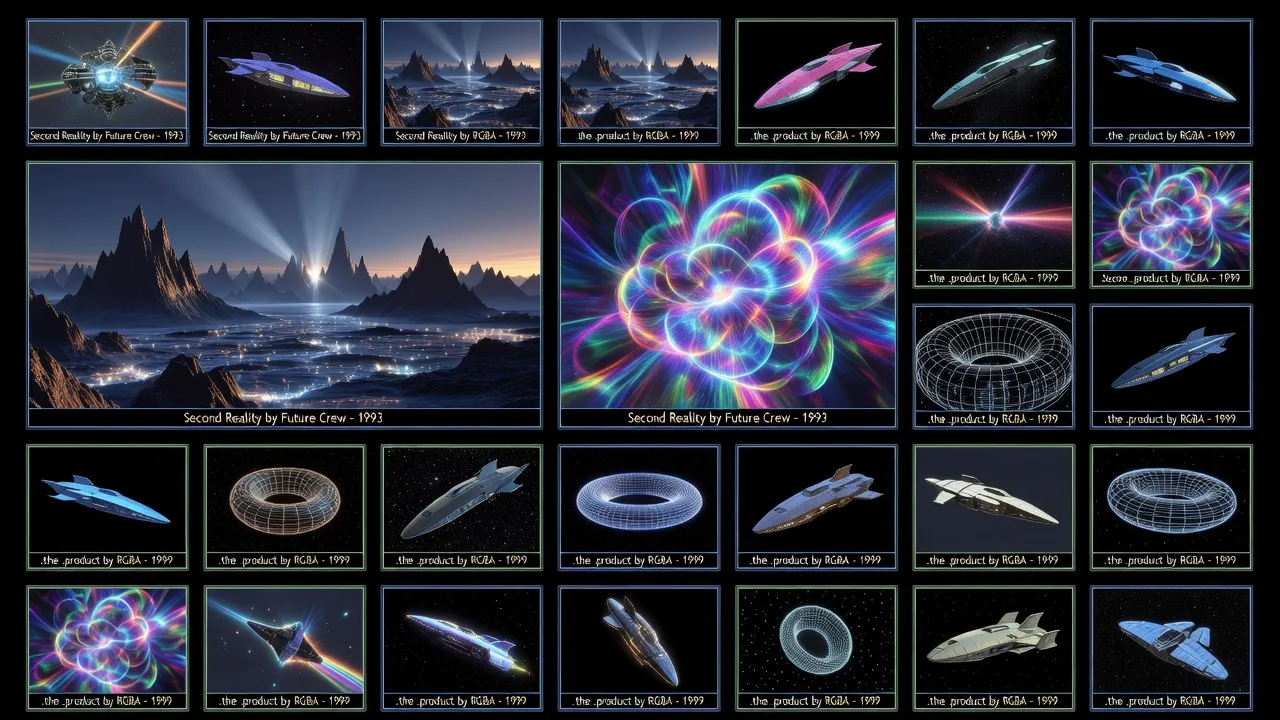
The late 1980s through 2000 marked the demoscene’s explosive growth on Amiga and early PC platforms, where groups like Future Crew and Spaceballs crafted works that defined the era’s aesthetics. Second Reality by Future Crew, released at The Party 1993, remains an iconic benchmark for its pioneering use of real-time 3D texture mapping and plasma effects on Intel 486 processors. The demo opens with a rotating cube that evolves into intricate tunnel sequences and morphing objects, all rendered via custom assembly optimizations that maximized the VGA’s 320x200 resolution while syncing to a pulsating soundtrack composed in Scream Tracker. Its technical innovations, including early environment mapping, influenced countless subsequent PC demos and even early 3D game engines.
Equally influential, 9 Fingers by Spaceballs on the Amiga, also from 1993, showcased the platform’s custom chipset capabilities with fluid vector graphics and multi-layered parallax scrolling. Running on an Amiga 500, it featured hand-drawn sprites animated at 50 frames per second alongside a chiptune score that incorporated sampled instruments for dynamic layering. The production’s technical context highlights clever copper list programming for color cycling effects, creating hypnotic visuals without taxing the 7 MHz Motorola 68000 CPU, cementing its status as a must-watch for Amiga enthusiasts.
C64 productions added a layer of 8-bit ingenuity, exemplified by Happiness is Around the Bend from Loonies. This demo leverages the Commodore 64’s VIC-II chip for intricate sprite multiplexing and raster interrupts, delivering scrolling landscapes and character animations within the machine’s 64 KB RAM limit. Its technical feats include cycle-exact timing routines that enable smooth 60 Hz playback, paired with a SID chip soundtrack that blends melodic leads with percussive effects, evoking a sense of nostalgic wonder through efficient 6510 assembly code.
Many of these works debuted at the parties where they premiered — Assembly 1993, Breakpoint, or Revision.
The Modern PC Demo Classics 2000-2015
As PC hardware advanced with faster CPUs and dedicated graphics cards, demoscene groups shifted toward more complex procedural content. Farbrausch’s fr-08 the product, unveiled in 2000, exemplifies this transition with its blend of 3D modeling and particle simulations running on Pentium III systems. The demo employs custom DirectX wrappers for hardware-accelerated rendering of volumetric fog and dynamic lighting, all while maintaining a compact executable that highlights efficient C++ optimizations and assembly tweaks for the era’s emerging 3D APIs.
Lifeforce by ASD, presented at Breakpoint 2008, pushed boundaries with advanced raytracing approximations and fluid simulations on contemporary GPUs. Built around a custom engine using OpenGL extensions, it features evolving organic forms and particle swarms synchronized to a layered electronic track, demonstrating how demoscoders adapted shader programming techniques typically reserved for commercial games to create breathtaking real-time sequences.
Size-Constrained Wonders: 64K and 4K Intros
Size limits foster remarkable creativity, forcing developers to generate entire worlds from minimal code. Farbrausch’s .kkrieger from 2004 stands as a landmark 96 KB first-person shooter, utilizing procedural texture synthesis and a compact Quake-like engine to deliver explorable environments with enemy AI and dynamic lighting. Its technical underpinnings rely on kkrunchy compression and hand-optimized x86 assembly to fit detailed 3D models and sound effects into such a tiny footprint, proving that full gameplay experiences could thrive under extreme constraints.
The rendering techniques in these classics now run on distributed infrastructure — i-Actu analyzes AI and cloud computing trends shaping creative tools that are reshaping what’s possible in real-time graphics.
Elevated by Rgba and TBC, released at Assembly 2009 as a 4 KB intro, achieves stunning mountain vistas and atmospheric effects through raymarching algorithms and fractal noise generation. Written primarily in C with inline assembly for DirectX, it leverages the GPU’s pixel shaders to compute landscapes on the fly, eliminating the need for large asset files while producing visuals that rival much larger productions.
Inspired? Learn how to start making your own demos with this practical beginner guide.
Standout Productions from 2015-2026
Recent years have seen demoscene works embrace modern GPUs and AI-assisted tools while honoring size and platform traditions. Productions like those building on .kkrieger’s legacy incorporate raytracing cores for photorealistic reflections in sub-64 KB packages, with groups experimenting with WebGL and Vulkan for cross-platform reach. Standouts often feature machine learning-driven music generation synced to evolving particle fields, maintaining the scene’s emphasis on live computation over baked assets. These entries continue to innovate with neural network upscaling for enhanced detail and real-time path tracing, ensuring the demoscene remains a fertile ground for technical experimentation amid evolving hardware.
Where to Watch Them
Viewers can access these classics through dedicated archives like Pouët.net, which hosts downloadable executables and video captures for nearly every mentioned production, including Second Reality and .kkrieger. YouTube channels such as Demoscene and individual group uploads provide high-quality recordings with commentary, while events like Revision and Demobit stream live showcases. For hands-on exploration, emulators like WinUAE for Amiga titles or DOSBox for early PC works allow running originals on modern systems, often with source code available via GitHub repositories from the original creators.