
The demoscene’s relentless drive for technical innovation and artistic expression has long relied on accessible, customizable tools that push hardware and creative boundaries alike. In 2026, open-source DAWs stand at the forefront of music production for intros, 64K demos, and full-sized productions, offering zero-cost entry points, full source transparency, and seamless integration with tracker formats or procedural generation pipelines that closed ecosystems often restrict. Whether crafting chiptune-infused electronic scores for a Revision compo entry or layering intricate breakbeats for a 4K demo by groups like Collapse or Logicoma, these platforms empower sceners to iterate rapidly without licensing hurdles.
Why Open-Source DAWs Matter for the Demoscene
Open-source DAWs align perfectly with the demoscene’s ethos of shared knowledge and reverse-engineering culture. Unlike proprietary tools locked behind subscriptions, projects such as OpenMPT and Ardour allow contributors to fork code, optimize for specific CPU constraints like those in 4K intros, or embed custom effects that match the visual shaders in a demo. This transparency proves vital when syncing audio precisely to 60 Hz frame rates or generating procedural melodies via Python scripts in Bespoke Synth. Sceners often cite the ability to compile lightweight builds for old-school Windows environments or integrate with tools like MilkyTracker for cross-format compatibility. Community-driven development also means rapid fixes for tracker quirks, such as handling S3M vibrato tables that appear in legendary productions like Second Reality’s soundtrack. Moreover, these DAWs foster collaboration across global parties, from TokyoDemoFest to Evoke, where contributors upload patches that enhance VST hosting or LV2 plugin chains essential for real-time rendering in live acts.
Many producers combine DAWs with trackers — our guide to tracker music tools that work alongside DAWs covers the hybrid workflow.
OpenMPT: The Tracker Standard
OpenMPT remains the cornerstone tracker for demoscene music, actively maintained in 2026 with nightly builds supporting Windows, macOS via Wine, and Linux through community ports. Its native handling of MOD, XM, IT, and S3M formats delivers pixel-perfect playback that matches the original Amiga and PC hardware emulations sceners demand. Key features include the instrument editor with per-sample panning and volume envelopes, the pattern matrix for complex multichannel arrangements, and built-in resampling options that emulate Paula or Sound Blaster fidelity without external plugins. Demoscene veterans rely on it for productions like the intricate XM modules in Andromeda’s “Stellar Dreamscapes” or the IT-based chiptunes powering Poo-Brain’s 64K entries at Revision. The software’s macro system lets users automate filter sweeps or arpeggios that sync to demo timelines, while its OPL3 and FM synthesis emulation shines in recreating AdLib sounds from 1990s classics. Sceners appreciate the undo history depth and the ability to import from older trackers like FastTracker 2, preserving legacy modules from groups such as Triton or Haujobb. Recent updates have added enhanced MIDI mapping for live performances and better integration with Cardinal for hybrid modular-tracker workflows, making it indispensable for both solo compo submissions and collaborative soundtracks.
LMMS: The Open-Source FL Studio Alternative
LMMS delivers a free, cross-platform alternative to FL Studio that resonates with demosceners seeking piano-roll workflows alongside tracker roots. Running natively on Windows, Linux, and macOS, it bundles the powerful ZynAddSubFX synth engine for lush pads and leads, alongside full VST2/VST3 hosting that expands its palette far beyond stock instruments. The song editor’s beat+bassline structure mirrors classic tracker channels while the automation curves support precise envelope drawing for sidechain compression effects popular in modern 4K demos. Notable demoscene applications include its use in creating layered electronic scores for Mercury’s “Vector Vistas” and procedural basslines in projects by group 0x1. Sceners leverage the built-in sample browser to pull from public domain chiptune archives and the LADSPA plugin support for vintage reverb simulations that evoke Amiga-era warmth. LMMS’s lightweight footprint allows compilation into minimal binaries for embedded demo playback, and its Python scripting hooks enable generative melody tools that feed directly into visual sync engines. Community forks have extended it with better SF2 soundfont handling, crucial for orchestral remixes in 128-byte music compos. At parties like Deadline, LMMS sessions often run alongside visual coders using the same machine for real-time adjustments.
Once your project is mixed, choosing the right audio formats for exporting your work determines the final quality and file size.
Ardour: Professional Recording on Linux/Mac/Windows
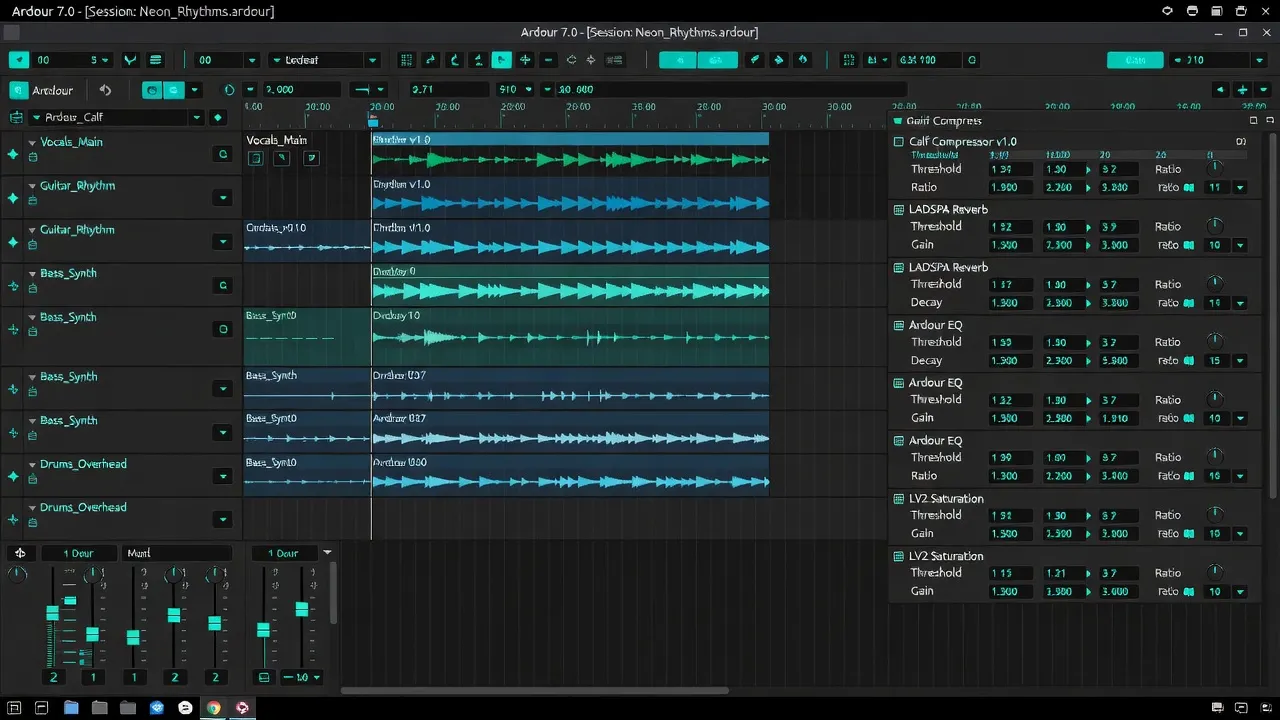
Ardour provides professional-grade multitrack recording and MIDI sequencing tailored for sceners who blend live instrumentation with electronic elements. Its cross-platform stability on Linux distributions popular at demoparties, plus native macOS and Windows builds, supports high-channel counts for surround mixes or intricate stems that accompany raymarched visuals. Core strengths include non-destructive editing, flexible routing matrices, and deep JACK integration for low-latency performance during live demo screenings. Demoscene creators have employed Ardour for hybrid productions such as the orchestral-electronic fusion in “Echo Chamber” by Still, layering field recordings with tracker-derived MIDI. The software’s region gain automation and spectral analysis tools help fine-tune frequencies to avoid clashes with demo visuals running at constrained resolutions. Recent 2026 enhancements include improved LV2 plugin hosting and export templates optimized for MP3 stems used in Pouët.net releases. Sceners value its session templating for rapid setup of 64K audio budgets, where every kilobyte counts, and its collaboration features that let remote contributors edit shared Ardour sessions over version control.
Audacity: The Essential Audio Editor
SoftAid’s comprehensive list of free and open-source creative software complements this guide with tools beyond the audio domain.
Audacity serves as the ubiquitous audio post-production companion, its open-source codebase enabling spectral editing and noise reduction techniques that polish raw tracker renders into competition-ready masters. Available on all major platforms, it excels at precise clip manipulation, with the 2026 version featuring enhanced real-time preview for effects chains and improved Nyquist scripting for custom batch processing. In demoscene workflows, it handles final mastering for tracks like the glitch-infused pieces in “Null Pointer” by Logicoma, applying notch filters to carve space for voice samples or vinyl crackle emulation. Its noise reduction algorithm proves invaluable when cleaning location recordings for narrative demos, while the spectrogram view aids in spotting phase issues before export. Many sceners script Audacity macros to normalize stems from OpenMPT sessions automatically, ensuring consistent loudness across 4K and 64K entries. The tool’s portability allows it to run from USB drives at parties, supporting quick edits during compo deadlines.
The next frontier is integrating AI — our guide to AI music generation tools that integrate with DAWs covers the plugins and workflows available in 2026.
Modular and Experimental: Bespoke Synth and VCV Rack
Bespoke Synth and VCV Rack, along with the Cardinal fork, open experimental frontiers for demoscene sound design through visual patching and scripting. Bespoke Synth’s infinite canvas and Python integration let users build generative sequencers that output MIDI to trackers or directly drive visuals, as demonstrated in algorithmic pieces for TokyoDemoFest entries. Its lightweight nature suits 4K constraints where procedural audio replaces sample bloat. VCV Rack simulates Eurorack modules with near-hardware accuracy, enabling complex feedback loops and CV modulation that sceners patch into Cardinal for LV2/VST export into Ardour or LMMS sessions. Cardinal’s added plugin formats expand compatibility, supporting demoscene hybrids like the modular chiptunes in recent Collapse productions. These tools foster innovation in live acts, where patches evolve alongside demo code in real time.
Comparison and Recommendations
Choosing among these DAWs depends on workflow preferences and demo constraints. Tracker purists gravitate to OpenMPT for its format fidelity and low overhead, while piano-roll enthusiasts favor LMMS for rapid prototyping. Ardour suits those needing multitrack depth, Audacity for polishing, and the modular trio for boundary-pushing experiments. In 2026, hybrid setups—OpenMPT feeding into Ardour via Cardinal—dominate high-ranking entries. Beginners should start with LMMS or Audacity for immediate results, advancing to OpenMPT for authentic tracker culture. All tools thrive on community contributions, ensuring the demoscene’s audio legacy remains vibrant and accessible.