
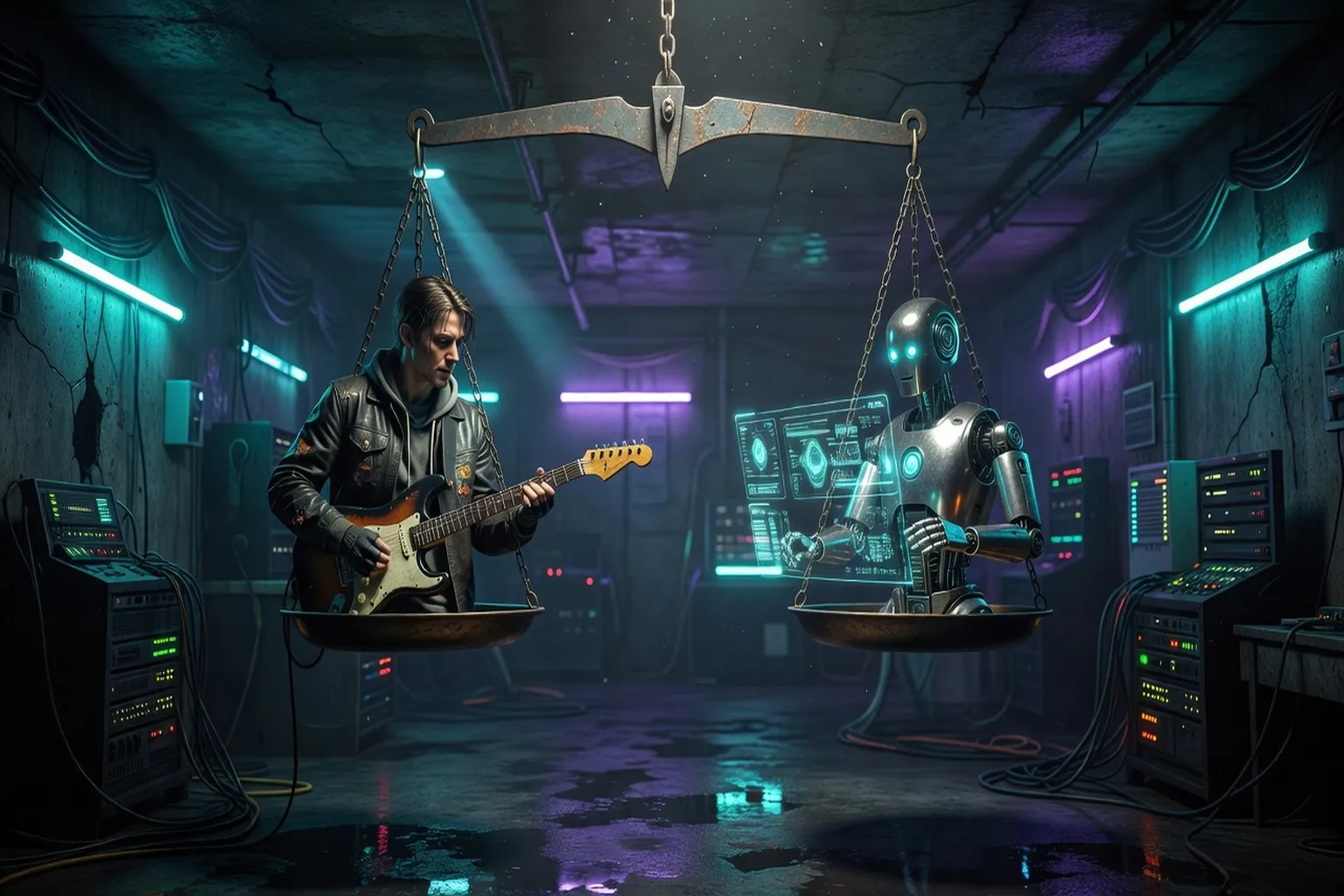
The Silence and the Roar: AI Music Crashes the Demoscene
The year is 2026. The main compo hall at Revision is electric, the air thick with the smell of Club-Mate and ozone. On the big screen, a stunning 64k intro fades to black. The next entry in the streaming music competition begins. A haunting, complex melody fills the space—a fusion of chiptune arpeggios, ethereal pads, and glitchy, procedural percussion that feels both nostalgic and impossibly new. The crowd is captivated. When the track ends, the applause is deafening. Then, the entry’s nfo file appears on screen. Under “Tools,” alongside familiar names like Renoise and VCV Rack, is a new one: “Melody & Harmony core generated with Udio Pro v3.2, post-processed and arranged in Ableton Live 12.”
A wave of murmurs ripples through the hall, quickly turning into a polarized roar of cheers and boos. This is the demoscene’s frontline in 2026. The debate over AI-generated art is no longer a theoretical discussion on forums; it’s playing out live at the world’s biggest digital art parties. Can a machine truly create? Does a meticulously crafted prompt constitute authorship? And in a culture built on pushing technical and creative limits from scratch, is using AI a brilliant new hack or a soul-crushing shortcut? This guide dives deep into the ethical maze, the copyright quagmire, and the evolving competition rules governing AI music in the modern demoscene.
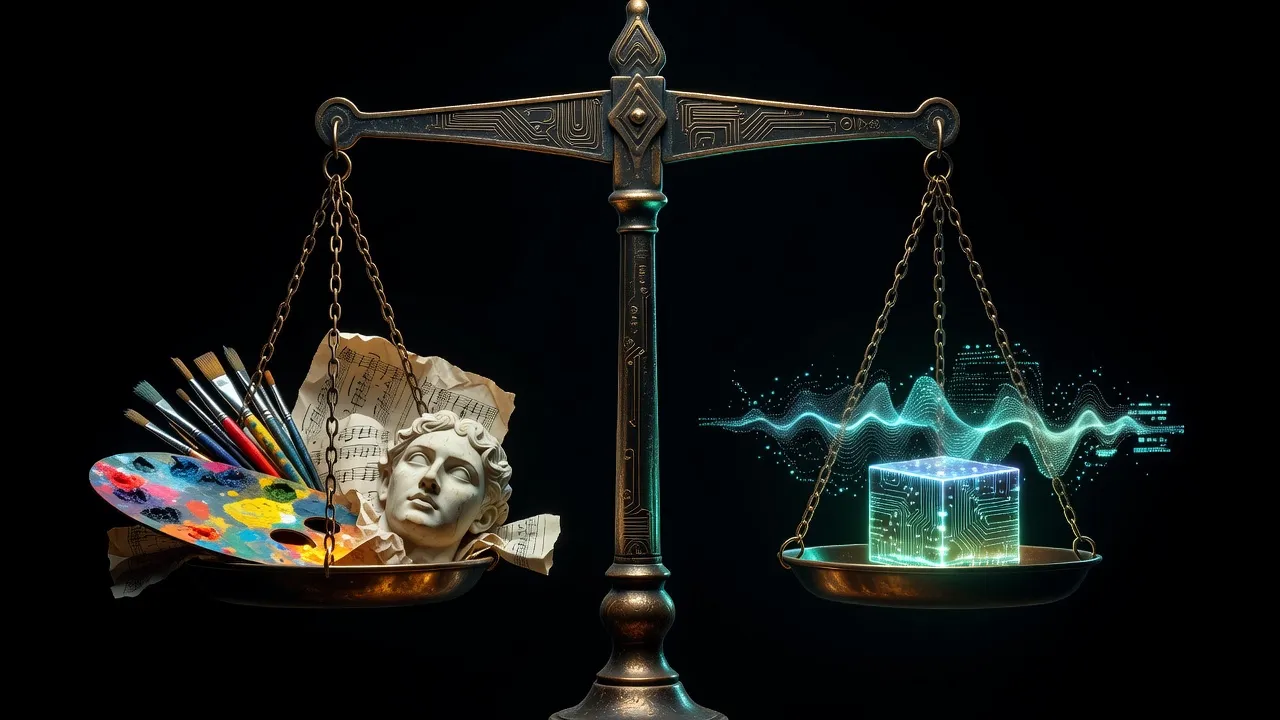
Rules of the Game: How Demoparties are Adapting (or Not)
By 2026, the demoscene is no longer a monolith in its response to generative AI. A fractured landscape of policies has emerged, forcing artists to carefully choose their venues. The stance of a demoparty often reflects its core philosophy, creating three distinct approaches.
First is the Purist Approach, championed by parties like Revision. Citing their long-standing tradition of human-centric creativity and “from scratch” ethos, Revision 2026’s rules for the main music competitions (e.g., Streaming Music, Tracked Music) are explicit: “The use of generative AI models for the creation of core melodic, harmonic, or structural components of a musical piece is forbidden. AI may only be used for sound design tasks (e.g., generating a single synth patch or sample) and must be clearly documented in the entry’s .nfo file.” This policy attempts to draw a line in the sand, preserving the musician’s role as the primary composer. Proponents argue this upholds the value of human skill, effort, and the years of practice required to master digital audio workstations and trackers. Critics, however, label this as technological gatekeeping, arguing that it stifles innovation and arbitrarily defines what parts of the creative process are “core” versus “tool-assisted.”
Second is the Segregated Approach, adopted by larger, more eclectic parties like Assembly Summer ’26. Recognizing the legitimacy of AI as a creative tool while respecting traditional methods, Assembly has introduced new competition categories. Alongside “Streaming Music,” they now host an “AI/Hybrid Music” compo. The rules for this category are designed to encourage transparency and highlight the human-AI collaboration: “Entries in this category must be created with significant use of generative AI. The .nfo file must include the model(s) used (e.g., Suno v4, Stable Audio 2.1), a summary of the key prompts, and a description of human post-processing and arrangement.” This creates a dedicated space for AI artists to compete on a level playing field, judged on criteria like prompt-craft, curation, and the quality of the final, human-polished composition.
Finally, there is the Anarchic Approach, unofficially embraced by smaller, more experimental gatherings like Solskogen. Here, the philosophy is simple: if the final product is good, the tools used are irrelevant. Their rulebooks often contain a single, elegant line: “All tools are allowed. Impress us.” This laissez-faire attitude treats AI as just another VST plugin, synthesizer, or DAW in the artist’s arsenal. It places the full burden of judgment on the audience and jury, who must decide for themselves whether an AI-generated track is more or less impressive than a human-composed one. This approach fosters maximum experimentation but also fuels the most intense debates about authenticity and the future of digital art.
Who Owns the Prompt? The Unsettled World of AI Music Copyright
The question of copyright ownership for AI-generated music remains one of the most contentious legal gray areas in 2026, with profound implications for demosceners. The core issue hinges on the legal standard of “human authorship,” a principle that copyright offices worldwide are struggling to apply to generative art.
The ethical questions arise from the AI music tools at the center of these debates — understanding the tools helps you engage with the controversy.
As of 2026, the prevailing legal precedent, heavily influenced by early rulings from the U.S. Copyright Office, is that the raw output of a generative AI model is not eligible for copyright protection. The reasoning is that the AI itself is not a legal person and the human user’s input—a text prompt—does not meet the threshold for “sufficient creative authorship” over the final, complex musical work. If you type “A fast-paced, 180 BPM Demoscene-style tracker chiptune with Amiga samples and a melancholic C-minor melody” into a model and it generates a complete song, that song, in its raw form, likely falls into the public domain. You cannot sue someone for using it.
However, the situation becomes far more complex with hybrid compositions. This is where most demoscene AI usage falls. If a musician generates a 16-bar chord progression with Suno v4, then exports it as MIDI, writes a new lead melody over it, programs their own drum patterns in Renoise, and performs a custom arrangement, the resulting work is a mix of AI-generated and human-authored content. In this scenario, the musician can likely claim copyright over the elements they created—the melody, the arrangement, the sound design—but not over the underlying AI-generated chords. This creates a legal minefield. How do you separate the two? If another artist uses the same AI to generate the exact same chord progression and builds a different song on it, is that infringement? The courts have yet to provide clear answers.
Furthermore, the Terms of Service for the AI platforms themselves add another layer of complexity.
- Udio Pro’s 2026 ToS might state that users are granted a broad, royalty-free license to use their generations for commercial purposes, but Udio retains certain rights to the outputs.
- Suno’s Enterprise plan might assign full copyright to the user, but this is a premium feature, and the legal enforceability of this “assignment” is still being tested in courts. For demosceners, who operate in a culture of sharing and remixing, this is a nightmare. Releasing a track made with a commercial AI tool at a party could mean you are inadvertently granting that company a license to your work, or that your track isn’t legally “yours” to submit in the first place.
The Ghost in the Training Data: Ethics, Originality, and Data Provenance
Beyond the legalities of copyright lies a deeper ethical question that strikes at the heart of the demoscene’s values: the provenance of AI training data. The incredible capabilities of models like Stable Audio 2.1 and Suno v4 are built upon a foundation of vast datasets, containing petabytes of music scraped from the internet. By 2026, landmark lawsuits filed by major record labels and artist guilds against AI companies are beginning to yield verdicts, but the landscape remains murky.
The central ethical dilemma is that many of these models were trained on copyrighted music without the original artists’ consent or compensation. The AI companies’ primary defense has been “fair use” (in the US) or “fair dealing,” arguing that the training process is transformative and creates a new tool, rather than a repository of copied works. Critics, including many demoscene musicians, call this “data laundering” or, more bluntly, “industrial-scale plagiarism.” They argue that the very “soul” of these models—their ability to understand melody, harmony, and rhythm—is derived from the uncredited labor of human artists.
This conflict directly challenges the demoscene’s emphasis on originality and “from scratch” creation. A core tenet of the scene is that you should understand your tools and create your assets yourself. Using a sample from a famous pop song in a demoscene track would be grounds for immediate disqualification and ridicule. Yet, using an AI model that was trained on that very same pop song (and millions of others) is a gray area. Is the AI-generated output a new, original work, or is it a high-tech collage of its training data, a “stochastic parrot” mindlessly remixing musical phrases it has memorized?
Understanding how proper prompt engineering shapes AI music creation is key context for the disclosure debate — if you cannot tell human from AI, what does authorship mean?
In response, a small but growing movement for ethically sourced AI is gaining traction. This involves models trained exclusively on public domain music, licensed stock music libraries, or on datasets where artists have explicitly opted in. In 2026, we’re seeing the first generation of these “ethical” models, such as OpenMusic-XL, trained on the Free Music Archive and other permissive sources. While their outputs are often less polished and versatile than their commercially-trained counterparts, they offer a compelling alternative for sceners who want to experiment with AI without compromising their ethical principles. The choice of which model to use has become a political statement in itself.
The Human Element: Hybrid Creation and the Fear of Displacement
The debate around AI in the demoscene is not just about rules and ethics; it’s a deeply personal conversation about the nature of creativity and the role of the artist. While headlines often focus on the fear of human artists being replaced, the reality on the ground in 2026 is far more nuanced, centered on the practice of hybrid creation.
Very few competitive demoscene entries are 100% AI-generated. The “one-click-and-done” approach rarely yields the specific, high-quality, and often technically constrained results that the scene values. Instead, AI is being integrated into the existing musician’s workflow as a powerful, if controversial, collaborator.
Consider these common hybrid workflows in 2026:
- The Idea Generator: A musician is stuck on a track. They use a tool like Riffusion-XL-2026 with a prompt like “chiptune, Amiga, fast arpeggios, C-minor” to generate a dozen short musical loops. They discard eleven but find one 4-bar melody that sparks an idea. They then manually transcribe that melody into their tracker (like ProTracker 3 or Renoise) and build an entire, original composition around it. Here, the AI acts as a “muse on demand.”
- The Sound Designer: An artist needs a specific sound effect for a 64k intro—say, “the sound of a digital soul shattering into a million pieces.” Instead of spending hours with complex synthesis in VCV Rack, they use a generative audio tool to create a hundred variations of this sound, then pick the best one, process it, and compress it to fit within the size limit.
- The Harmonic Assistant: A talented drum programmer and sound designer struggles with music theory. They use an AI to generate a complex chord progression that fits the mood of their track, then use their human skills to craft the rhythm, bassline, and overall production around that AI-generated harmonic foundation.
The rules and values of how demoscene competitions are structured and judged provide the context in which AI disclosure policies are being debated.
These hybrid methods challenge the romantic notion of the solitary genius artist. Proponents argue this is no different from using a new synthesizer with advanced presets, a sample pack, or a MIDI chord pack. They see AI as a tool that democratizes certain skills (like music theory) and frees up the artist to focus on what they do best—be it arrangement, sound design, or mixing.
However, the fear of artist displacement is real. For musicians who have spent decades honing their craft, the idea that a machine can generate musically competent ideas in seconds can be deeply demoralizing. The concern is not just about competition entries, but about the perceived devaluation of human skill. If melody and harmony can be automated, what is the musician’s value? The counter-argument is that the uniquely human elements—taste, curation, storytelling, emotional expression, and the ability to weave sound into a cohesive, compelling narrative for a demo—remain irreplaceable. The best hybrid tracks are not those where the AI does the most work, but where a human artist skillfully guides, edits, and integrates the AI’s output into a vision that is uniquely their own.
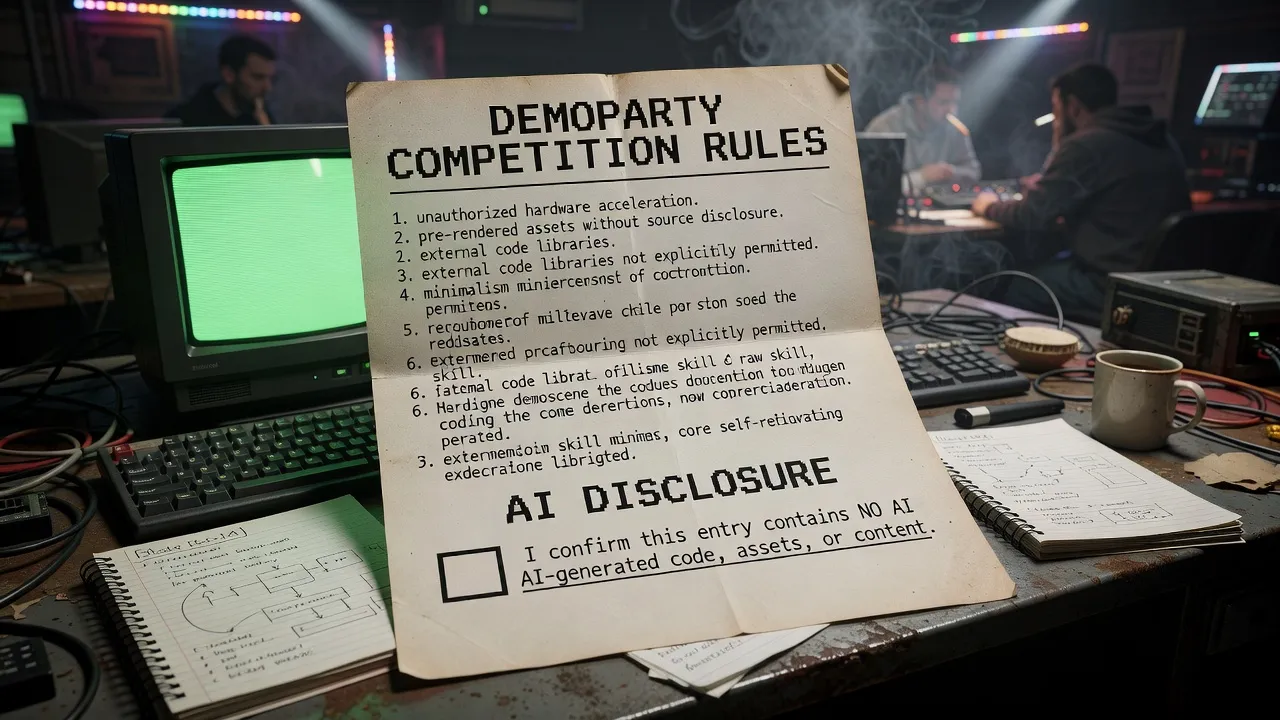
“Show Us Your .work”: Attribution and Transparency in the AI Era
In the demoscene, transparency has always been a cornerstone of the culture. From the early days of sharing assembly source code to the modern practice of releasing “making-of” videos and project files, showing your work is a sign of respect for the community and a way to share knowledge. As AI tools become integrated into creative workflows, this tradition is being adapted to a new technological paradigm. The simple credit line “Music by ArtistX” is no longer sufficient.
By 2026, a new standard for attribution is solidifying, especially at parties with dedicated AI/Hybrid categories. The community expects a level of detail that demystifies the creative process. A simple .nfo file for an AI-assisted track is now expected to look something like this:
.--------------------------------------------------------------------.
|         'Chrome Reflections' by QuantumLeap of SceneRangers        |
+--------------------------------------------------------------------+
|                                                                    |
|   Greetings to all at Assembly Summer '26! This track was a fun    |
|   collaboration between man and machine.                           |
|                                                                    |
|   - Primary Tools: Ableton Live 12, Renoise 3.4.3                  |
|   - VSTs: Serum, Valhalla Supermassive                             |
|                                                                    |
|   - AI Usage Details:                                              |
|     - Model: Udio Pro v3.2 ('Maestro' engine)                       |
|     - Prompt for Pads: "Lush, evolving analog-style pads in        |
|       E-flat minor, slow attack, long release, Blade Runner 1982   |
|       soundtrack vibe, 4 bars, 90 BPM." (approx. 5 generations)     |
|     - Post-processing: Generated pads were rendered to audio,      |
|       chopped, rearranged, and processed with Valhalla reverb.      |
|     - All other elements (drums, bass, lead melody, arrangement)   |
|       were composed and programmed manually in Renoise.            |
|                                                                    |
'--------------------------------------------------------------------'
The ethical debate connects to deeper questions about creativity — effervesciences.fr provides science-backed perspectives on creativity and AI that inform the competitive fairness discussion.
The AI tools drawing the most scrutiny are covered in our tool comparison guide.
This level of transparency serves several crucial purposes. First, it is honest. It gives credit where it’s due, acknowledging the role the AI played without overstating it. It allows the audience and jury to accurately assess the human contribution. Second, it is educational. It shares knowledge about prompt-craft and integration techniques, aligning with the scene’s spirit of open learning. Fellow artists can see how a tool was used, not just that it was used. Third, it establishes a new form of skill. The art of writing effective prompts, curating the best outputs from dozens of generations, and skillfully blending them with manually created elements is a legitimate creative process in itself. Detailed attribution allows this new skillset to be recognized and celebrated.
Forcing this transparency prevents a “black box” scenario where audiences are left guessing about a track’s origin. It’s the demoscene’s cultural immune response, ensuring that even as tools become exponentially more powerful, the values of honesty, skill-sharing, and human creativity remain at the forefront.
The economics of AI music platforms are inseparable from their ethics — i-Actu’s analysis of AI infrastructure and the economics of creative tools contextualizes who controls these systems.
Practical Tips / Getting Started with AI Music in 2026
For the curious demoscener looking to experiment with AI music ethically and effectively, here is a practical guide to getting started.
1. Choose Your Tools Wisely:
- Commercial Powerhouses (for Ideation):
- Suno v4 / Udio Pro v3: Excellent for generating complete song structures or high-quality instrumental loops with natural-sounding instruments. Best for brainstorming and generating foundational ideas. Be mindful of their Terms of Service regarding ownership.
- Stable Audio 2.1: More focused on sound design, textures, and shorter loops. Great for creating unique samples and SFX.
- Open-Source & Local Models (for Control & Ethics):
- Riffusion-XL-2026: An improved spectrogram-based model that you can run locally on a modern GPU. Offers more control over the output and ensures your work stays private. Often requires more technical skill to set up.
- Mustang (Meta’s Audio Gen 2 successor): A powerful open-source