
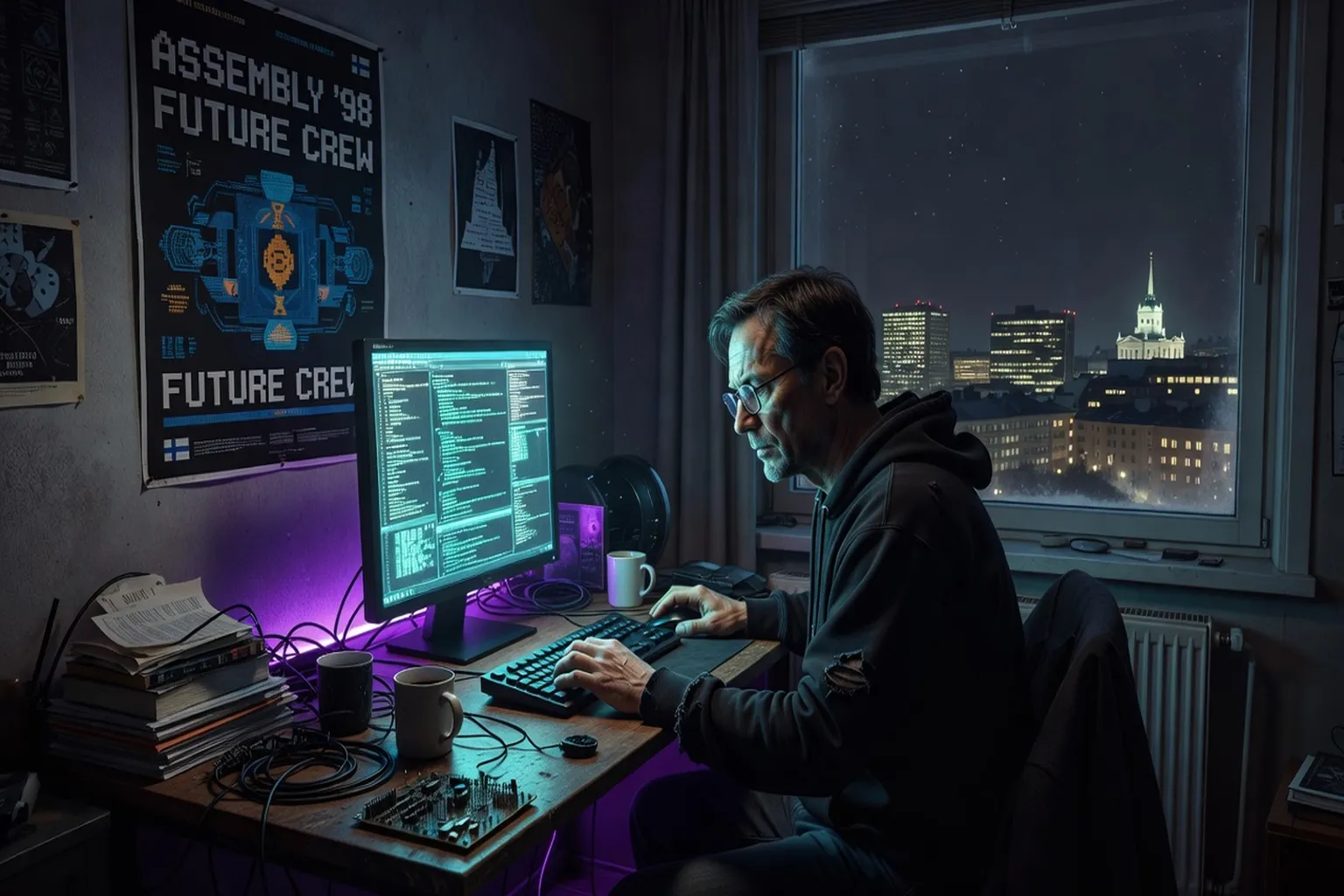
About Mikko Virtanen
Helsinki, Finland, 1999. A young Mikko Virtanen, captivated by the flickering pixels and pulsating rhythms emanating from his elder brother’s PC, took his first tentative steps into the demoscene. Armed with a copy of Scream Tracker and a nascent understanding of C++, he began crafting his own digital worlds, fueled by the scene’s ethos of pushing hardware to its limits. His early work quickly gained recognition for its innovative visual effects and surprisingly intricate musical compositions, often developed under the alias “Synthwave” before he found his stride. In the early 2000s, Mikko co-founded the legendary demogroup “Byterate,” a collective known for their highly technical 64k intros and their distinctive blend of melancholic melodies and vibrant, real-time graphics. For two decades, Mikko remained a stalwart of traditional demoscene production, mastering tracker music and low-level coding. However, as AI music generation tools began to emerge and mature, Mikko, ever the innovator, saw not a threat, but a new frontier. He embarked on a journey to seamlessly integrate these cutting-edge AI capabilities with the time-honored craft of tracker music, pioneering a “hybrid approach” that continues to redefine the sonic landscape of modern demos.
The tools Mikko references are covered in detail in our AI music generation complete guide, which compares platforms across multiple dimensions.
For those unfamiliar with Mikko world, our primer on what is the demoscene provides essential context.
[Expert card placeholder — image will be inserted here] Mikko Virtanen | Demoscene Veteran & Coder | Helsinki, Finland | 25 years in the scene
“The Scene Changed Overnight”: A Conversation with Mikko Virtanen
The demoscene has always thrived on innovation, pushing the boundaries of technology and creativity. But few shifts have been as seismic as the recent explosion of AI music generation. To understand this profound transformation and its impact on the heart of the scene, we sat down with Mikko Virtanen, a demoscene veteran whose 25-year journey has seen him evolve from a tracker purist to a pioneer of AI-infused demoscene audio. From his studio in Helsinki, Mikko shared his insights on how AI is not just changing the tools, but reshaping the very essence of demoscene music.
The chiptune traditions Mikko describes as foundational are explored at length in our chiptune complete guide.
Mikko toolkit overlaps significantly with the platforms reviewed in our best AI tools for music production, a useful companion piece.
Q: Mikko, you’ve been coding demos since 1999. How has the introduction of AI music tools changed the demoscene? A: It’s been nothing short of revolutionary, honestly. The scene, as I knew it, changed overnight. For decades, the demoscene’s audio landscape was dominated by tracker music, chiptunes, and occasionally some pre-rendered samples. The craftsmanship was entirely human — every note, every beat, every effect meticulously placed by hand. Then suddenly, we have tools like Suno, AudioCraft, and a host of others that can generate entire musical pieces, or at least substantial stems, with a few text prompts. The initial reaction, understandably, was a mix of awe and apprehension. Awe at the sheer potential for new textures and complexities we could never achieve with traditional methods, and apprehension about what this means for the “human element” that has always been so central to our art form. Some immediately embraced it, seeing it as a powerful new instrument. Others viewed it with deep skepticism, concerned about originality and the very definition of “making music” in the scene. But regardless of where you stand, there’s no denying it has opened up entirely new avenues for sound design and composition, allowing us to experiment with genres and moods that were previously out of reach for a typical demoscener’s toolkit. It’s a seismic shift, and we’re still navigating its aftershocks.
Q: Can you walk us through your current workflow when creating audio for a demo? A: Absolutely. My workflow today is a true hybrid, a dance between AI and traditional tracking. I always start with a core concept or a mood board for the demo. What kind of emotional arc do we want? What’s the visual style? This dictates the initial sonic direction. Let’s say we’re aiming for a melancholic, futuristic vibe. I’ll begin by using AI tools like Suno or even some of the more experimental custom models I’ve trained, to generate atmospheric pads, ambient textures, or even some initial melodic seeds. I’ll feed them prompts like “sci-fi ambient soundscape, melancholic, evolving pads, subtle arpeggios.” I might generate several variations until I find something that truly resonates. Once I have these AI-generated “stems” – usually long, evolving audio files – I’ll import them into OpenMPT, my trusty tracker. This is where the human touch truly comes in. I’ll then layer traditional tracker patterns over these AI foundations: punchy chiptune leads, intricate drum breaks, basslines, and effects that are all meticulously programmed by hand. The AI provides the broad strokes and complex textures, while I provide the precise rhythm, melody, and structure that define the demoscene sound. Finally, it’s all about mixing, mastering within the tracker, and ensuring perfect synchronization with the demo’s visuals. It’s a highly iterative process, constantly bouncing between what the AI offers and what I can shape and refine with my own hands.
Q: You’ve mentioned you still use OpenMPT alongside AI. Why not switch entirely to AI-generated music? A: That’s a crucial question, and it gets to the heart of why I believe the human touch in tracker music is irreplaceable. While AI can generate incredibly complex and beautiful sounds, it often lacks what I call the “soul” or the intentionality that comes from a human composer. Tracker music, especially chiptune, has a very specific character. It’s about raw, deliberate synthesis, often with limitations that force creativity. Every note, every effect, every instrument definition in OpenMPT is a direct expression of the artist’s intent. There’s a certain “grit” and precision to a hand-coded pattern that AI, for all its sophistication, struggles to replicate authentically. It might generate something similar to a chiptune, but it often misses the subtle nuances, the deliberate imperfections, or the specific melodic phrasing that a human tracker musician would inject.
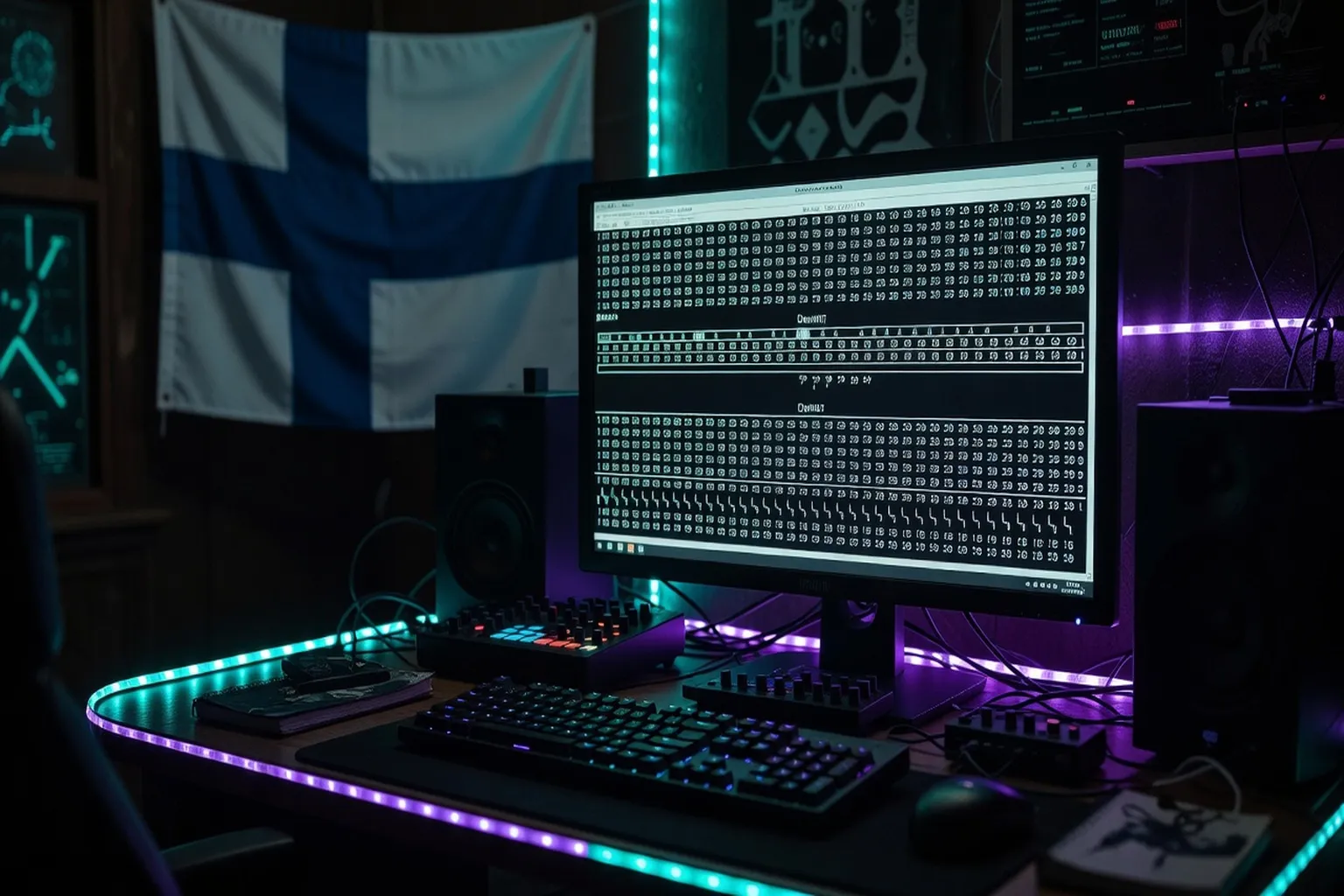
Furthermore, the interactive nature of tracking is fundamental to my creative process. I’m not just generating; I’m composing, arranging, and performing in real-time within the tracker interface. AI is excellent for generating textures, complex pads, and even some surprisingly good melodic ideas that I might never have conceived myself. It handles certain ambient washes or evolving soundscapes with an effortlessness that would take me hours of painstaking synthesis. But for the driving leads, the intricate drum patterns, the emotional core of a piece, and especially for the precise sync required in a demo, the direct control and intentionality of OpenMPT remains unmatched. It’s about leveraging each tool for its strengths: AI for expansive, often unpredictable textures, and the tracker for precise, intentional, and soulful composition.
Q: What AI tools have you integrated into your workflow, and which ones actually survived past the initial experimentation? A: My toolkit has evolved quite a bit since I started experimenting seriously in 2021. For ambient layers and evolving soundscapes, Suno has become a surprisingly powerful ally. Its ability to generate coherent, genre-specific pieces from simple text prompts, often with interesting vocal-like textures, makes it fantastic for creating those broad, atmospheric pads that give a demo its initial mood. I usually generate several variations, pick the best one, and then chop it up or process it further in my DAW or even within OpenMPT using samples.
For more granular sound design and specific effects, I’ve found AudioCraft (especially its MusicGen and AudioGen components) to be invaluable. It’s great for generating short bursts of sound, specific foley, or even abstract sonic textures that can be layered into the mix. If I need a “futuristic computer hum” or a “glitchy data stream” sound, AudioCraft can often deliver a great starting point.
As Mikko explains throughout this interview, the tracker music revival guide provides essential context for understanding how AI fits into traditional scene workflows.
Finally, for melody generation seeds, I still occasionally use Google Magenta’s various models, particularly MusicVAE or NSynth. They’re more experimental and require more effort, but they can sometimes spit out a truly unique melodic phrase or arpeggio that I can then refine, transpose, and adapt into a chiptune lead in OpenMPT. It’s less about generating full melodies and more about sparking inspiration.
Now, as for what didn’t survive: many of the early, more generic “AI music generators” that promised full songs with a single click often fell flat. They produced bland, uninspired, and often repetitive music that lacked any real character or emotional depth. They were good for a novelty, but useless for creating compelling demoscene audio. Also, some of the more complex, local inference models were too resource-intensive or too finicky to integrate smoothly into a fast-paced demo production pipeline. The key for me has been finding tools that excel at specific tasks and complement, rather than try to replace, my existing skills.
Q: There’s been heated debate about AI music in demoscene competitions. What’s your take? A: It’s definitely a hot topic, and rightly so. The debate typically boils down to “AI as an instrument” versus “AI as a replacement.” My take is firmly in the “AI as an instrument” camp. If you’re using an AI tool to generate a sound, a texture, or even a melodic idea that you then process, arrange, and integrate into your composition, much like you would with a synthesizer or a sample library, then I see no fundamental issue. It’s just another tool in the artist’s arsenal, expanding the palette of possibilities. The human creativity and skill still lie in the selection, arrangement, and overall artistic vision.
However, if someone is simply prompting an AI to generate a full, finished track and submitting it without significant human intervention or creative input, then I think that crosses a line. That feels more like content generation than artistic creation, and it dilutes the spirit of the demoscene, which has always been about demonstrating personal skill and pushing boundaries through code and art.
Most major demoparties, like Assembly, are still grappling with how to formulate clear rules. Some have adopted a “human-authored” clause, requiring a certain percentage of the work to be human-created. Others are focusing on transparency, asking artists to disclose their use of AI. I believe transparency is key. Let the audience and the judges know what tools were used. Ultimately, the community will adapt, as it always has. The best AI-assisted music will shine through because it still has that spark of human ingenuity. The goal should be to encourage innovation while preserving the core values of craftsmanship and originality that define our scene.
Q: For someone coming from a traditional music background wanting to enter the demoscene in 2026, what would you recommend? A: That’s a fantastic question, and the answer is probably more exciting now than ever before! First, don’t be intimidated by the coding aspect. While demoscene is about code, many artists focus primarily on graphics or music. For music, I’d strongly recommend diving into OpenMPT (Open ModPlug Tracker) or Renoise. These are modern trackers that offer a fantastic blend of traditional module tracking and more contemporary features. Learning the tracker workflow will give you a fundamental understanding of how demoscene music is structured and optimized, which is crucial.
Next, start experimenting with AI tools, but with a specific goal. Don’t just generate random stuff. Think about what textures or sounds you can’t easily create in a tracker. Try using Suno for ambient pads, AudioCraft for sound effects, or even some of the more niche AI tools for specific melodic phrases. Learn how to generate, then critically evaluate, and finally integrate these elements into your tracker compositions. Think of AI as a powerful, but sometimes unpredictable, co-composer.
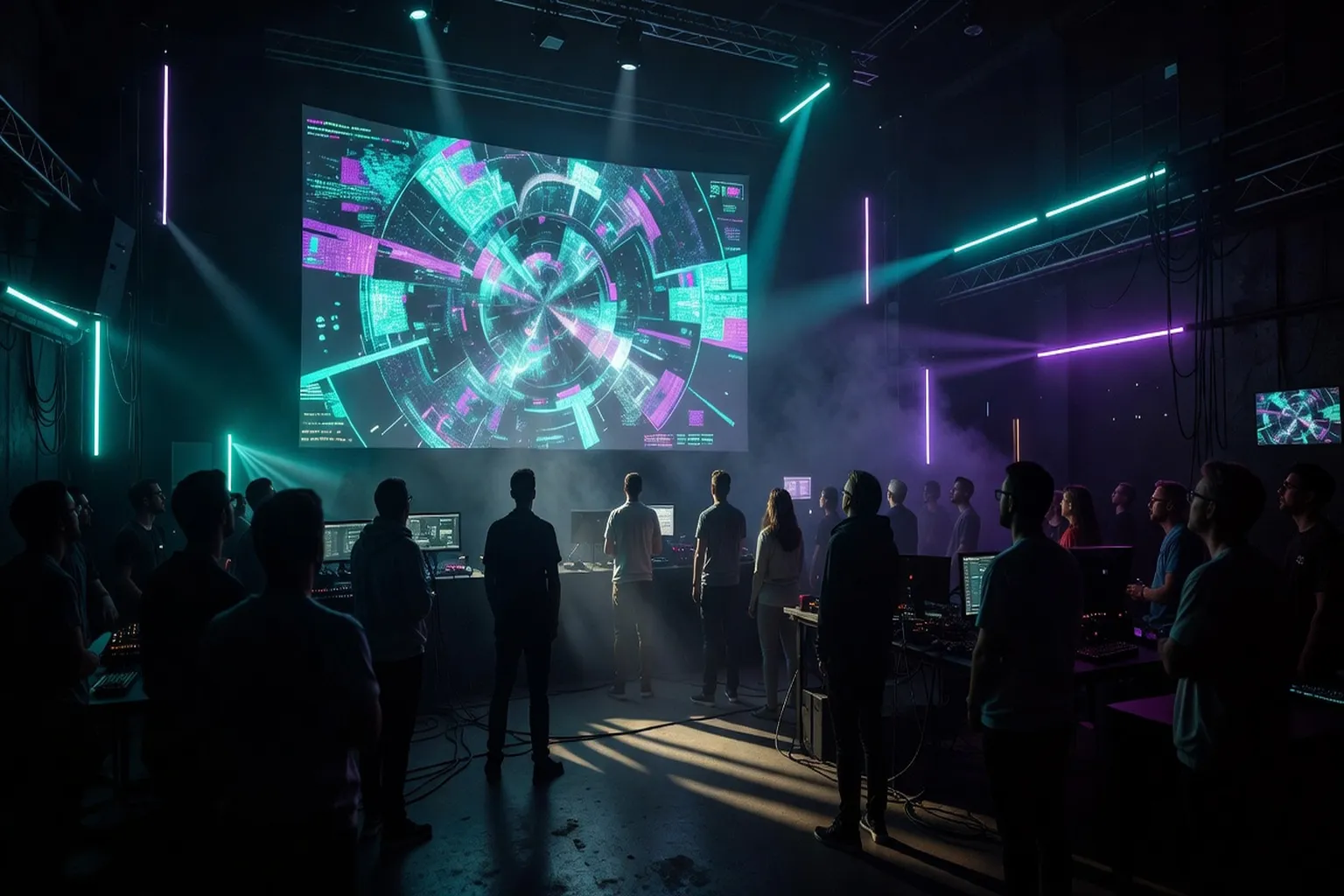
Beyond tools, immerse yourself in the demoscene community. Join forums like Pouët.net, watch older demos on YouTube (search for “Assembly demo party” or “Revision demo party”), and most importantly, attend a local or online demoparty if you can. See what others are doing. Learn from the legends. The demoscene is incredibly welcoming to new talent, especially those with strong artistic skills. Don’t be afraid to ask questions, share your work, and collaborate. Start small, perhaps by contributing music to a tiny intro or a 4k production. The journey is incredibly rewarding.
Q: You’re known for your “hybrid approach.” Can you describe a specific demo where this worked particularly well? A: Certainly. One demo where this hybrid approach truly gelled was “Byterate - Neon Solstice,” a 64k intro we released last year. The core concept was a journey through a cyberpunk city at dawn, evolving from dark, oppressive streets to the golden glow of a new day. For the music, I knew I needed something that felt both gritty and ethereal.
I started by generating several long, evolving atmospheric pads using a custom AI model I’d trained on industrial ambient soundscapes and ethereal synthwave. These AI-generated layers provided the foundational “hum” and emotional backdrop for the entire track – a subtle, almost subliminal sense of a vast, breathing city. They gave me these complex, unpredictable textures that would have been incredibly difficult and time-consuming to synthesize from scratch in a tracker, let alone fit into a 64k limit.
Then, I brought these into OpenMPT. Over these AI pads, I meticulously crafted the main melodic lines using classic chiptune instruments – square waves, saw waves, and triangle waves – giving the track its distinctive demoscene character. The bassline was a punchy, hand-programmed sawtooth pattern, and the drums were all sampled 8-bit percussive sounds, sequenced with precise, intricate breaks. The AI provided the atmospheric “canvas,” and my tracker work provided the “brushstrokes” that defined the melody, rhythm, and the emotional progression. The result was a track that felt incredibly rich and layered, yet still retained that crisp, direct energy of traditional demoscene music. The AI added depth and scope, while the tracker kept it grounded and impactful.
Sceners curious about the ethical dimensions Mikko briefly touches on will find more in our dedicated piece on AI music ethics and competitions.
Q: What do you think the demoscene will look like in five years with AI tools maturing? A: In five years, I believe AI tools will be completely integrated into the demoscene workflow, becoming as commonplace as a modern DAW or a 3D modeling package. We’ll see more specialized AI models, perhaps even demoscene-specific ones, trained on vast datasets of tracker music and visual styles, allowing for even more seamless integration. This will likely lead to an explosion of creativity. Demos could feature incredibly intricate soundscapes generated by AI, perfectly synced with visuals that are themselves partially AI-generated or assisted.
However, I don’t think the core identity of the demoscene will be lost. The emphasis on technical prowess, on pushing limits, and on human ingenuity will remain. Instead of asking “Can we make a demo with AI?”, the question will shift to “How can we make the most artistic and innovative demo using AI?” The human element will pivot from pure generation to curation, direction, and refinement. We might see artists specializing in “AI prompting engineering” for sound design, or in training custom models to achieve very specific aesthetic goals.
There will always be a place for purists who create everything by hand, and their work will be valued for its traditional craftsmanship. But the majority will likely embrace a hybrid approach. The scene will become even more diverse, with new genres and styles emerging from this fusion. It’s an exciting prospect – more tools, more possibilities, and ultimately, more breathtaking demos for everyone to enjoy. The challenge will be to maintain the scene’s ethos of skill and originality amidst this new wave of powerful assistive technology.
Q: Any final advice for sceners who are still skeptical about AI tools? A: My main advice would be this: approach AI with an open mind, and treat it as just another instrument in your toolkit. Don’t see it as a replacement for your skills, but rather as an extension of your capabilities. Just as a guitarist learns to master a new pedal or an electronic musician learns a new synthesizer, you can learn to master AI tools. They are not magic black boxes; they are sophisticated algorithms that respond to your input and your artistic direction.
Start small. Don’t try to generate a full track immediately. Experiment with generating a simple pad, a unique drum loop, or a sound effect that you then integrate into your existing tracker project. See how it interacts with your human-made elements. You might be surprised by the unexpected synergies that emerge. The demoscene has always been about embracing new technologies and bending them to our creative will. AI is just the latest, and arguably one of the most powerful, new technologies to emerge. It’s an opportunity to innovate, to break new ground, and to create sounds and experiences that were simply not possible before. Don’t get left behind; explore, experiment, and find your own unique way to incorporate it into your artistic vision. The scene thrives on pushing boundaries, and AI is simply the newest boundary to push.
Rapid Fire with Mik
This perspective on how traditional music forms influence digital composers resonates with Mikko view that the best AI-assisted music has deep roots in acoustic tradition.
Research into science-backed approaches to creative performance parallels Mikko observation that mental state directly affects the quality of AI-assisted compositions.