
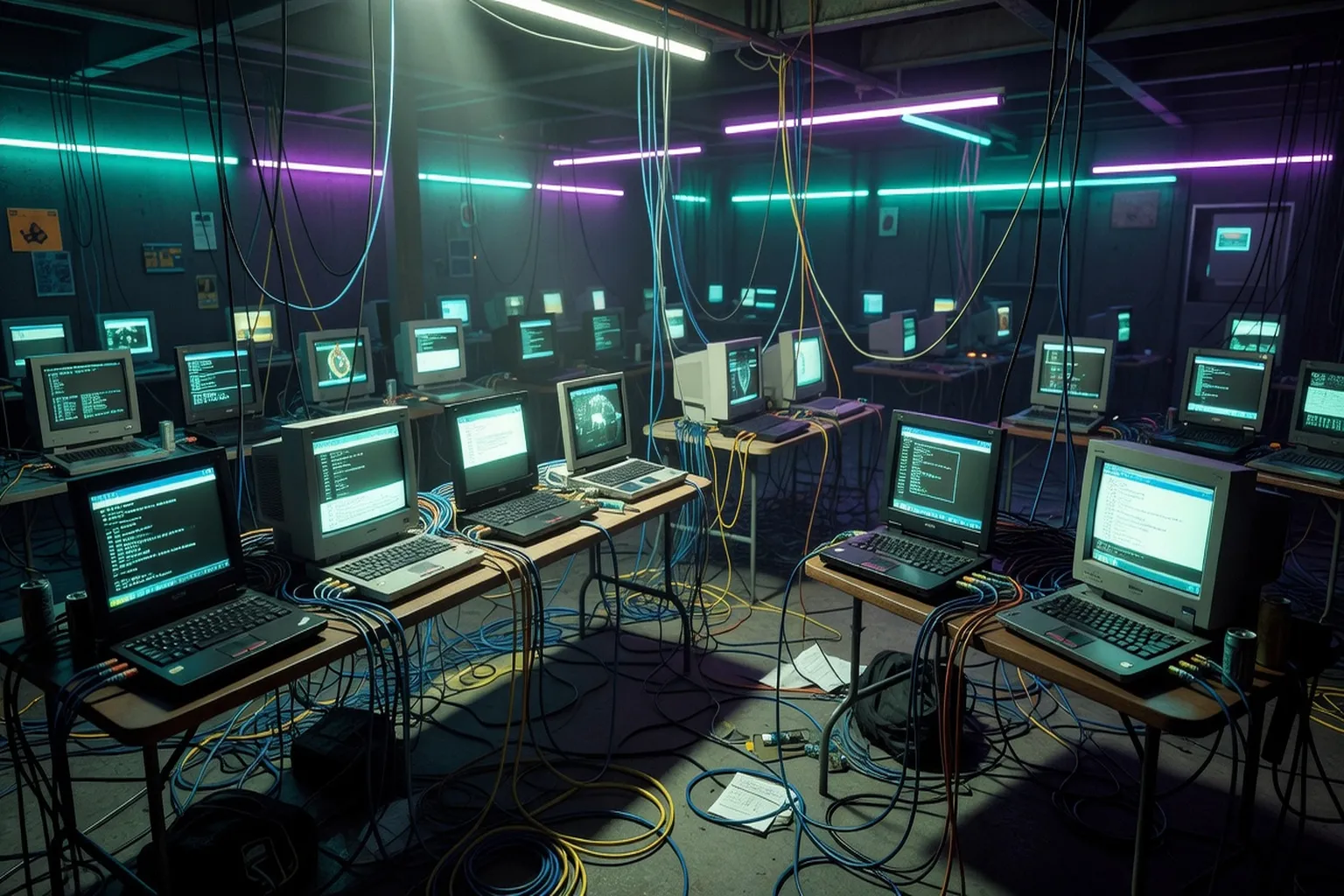
In the annals of demoscene history, certain events stand out as monumental showcases of technical prowess and artistic innovation. Yet, just as crucial to the scene’s vibrant ecosystem are the smaller, more intimate gatherings – the community parties that foster talent, forge connections, and preserve the grassroots spirit. Among these, Stream MEGA 2005 holds a special place, an event that, while perhaps not as globally renowned as an Assembly, was undeniably vital to the Finnish demoscene and beyond. Held in the picturesque town of Ylöjärvi, near Tampere, Finland, from September 16-18, 2005, Stream MEGA was more than just a party; it was a microcosm of the demoscene’s enduring appeal, a testament to the dedication of its organizers, and a snapshot of a particular moment in its evolution. Organized by Matt Current, better known as Jean Nine, this installment of the Stream series (which ran from 2003 to 2011) offered an open invitation to the world, notably providing free entry for international visitors—a gesture that underscored its commitment to inclusivity and cross-border collaboration.
Stream MEGA 2005: The Event
Stream MEGA 2005, nestled in the quiet surroundings of Ylöjärvi, just a short distance from the bustling city of Tampere, offered a distinct counterpoint to the larger, more commercialized demoscene gatherings. For three intense days, from September 16th to 18th, 2005, the chosen venue—likely a local community hall or school gymnasium, typical for events of this scale—transformed into a buzzing hub of creativity. The atmosphere was palpably different from that of a massive convention center; here, the focus was less on spectacle and more on direct interaction, shared knowledge, and the raw act of creation. Organizer Matt Current, known in the scene as Jean Nine, was the driving force behind this particular iteration of the Stream series, a testament to the passion of individuals who dedicate countless hours to sustaining these vital community nodes.
The decision to offer free entry for international visitors was a cornerstone of Stream MEGA’s ethos. This wasn’t merely a promotional gimmick; it was a deliberate statement about accessibility and community. It encouraged enthusiasts from across Europe and even further afield to make the journey, fostering a truly international, albeit intimate, exchange of ideas and talent. Imagine the scene: a mix of Finnish demosceners, many of whom were already legends or rising stars, mingling with visitors from Sweden, Germany, the Netherlands, and beyond. Language barriers dissolved in the shared pursuit of pixel perfection, algorithmic elegance, and sonic innovation. Attendees would typically arrive with their trusted hardware—PCs, Amigas, or even C64s—ready to plug into the local area network (LAN), set up their temporary coding stations, and dive into the collaborative chaos. Sleeping arrangements were often Spartan, with sleeping bags rolled out directly on the floor, adding to the communal, almost camp-like feel. Projectors cast flickering images of work-in-progress demos and trackers onto makeshift screens, while the ubiquitous hum of computer fans and the click-clack of keyboards formed a continuous soundtrack to the creative process. The event was a testament to the DIY spirit that has always defined the demoscene, a place where the barrier to entry was low, and the rewards were measured in shared experiences and creative breakthroughs rather than monetary gain. It was a true melting pot of ideas, where informal discussions and spontaneous collaborations were as important as the official competitions, embodying the very essence of a grassroots creative movement.
The Finnish Demoscene in 2005
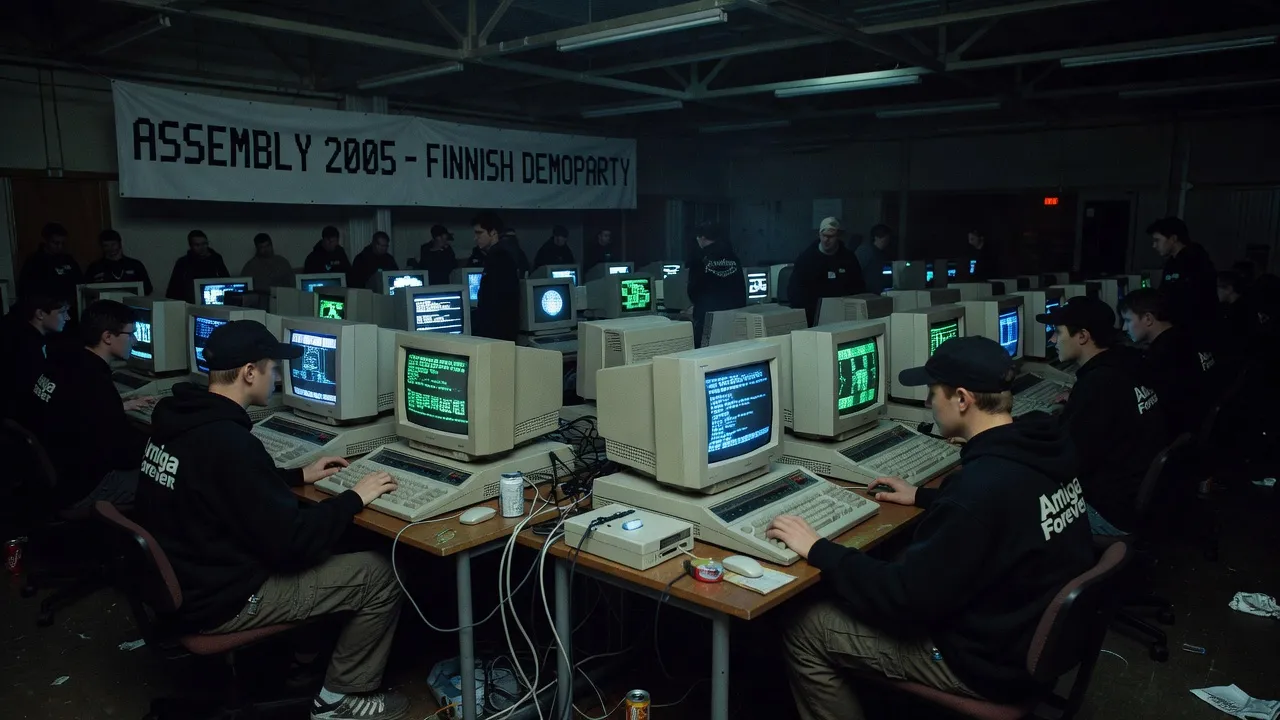
The Stream parties were embedded in the demoscene culture that produced this event — an underground world of coders and artists.
In 2005, the Finnish demoscene was a powerhouse, a global leader consistently pushing the boundaries of real-time computer graphics, music, and code. It was a period affectionately described as “post-Assembly, pre-Revision,” meaning that while Assembly Summer was the undisputed annual zenith for many Finnish demosceners, the now-dominant springtime Revision party had yet to fully establish itself as a major international fixture. This left a significant gap in the calendar, which regional parties like Stream MEGA were instrumental in filling. The Finnish scene boasted an incredibly rich history, from the legendary Future Crew in the early 90s to the continued output of groups like CNCD, Orange, and Fairlight (though Fairlight had a strong Swedish contingent, its presence and influence in Finland were undeniable). Many prominent individuals like Pasi “Darklight” Hytönen, Jari “Jal” Komppa, and Antti “Gore” Peltola were actively shaping the scene with their innovative techniques and tools.
The technological landscape of 2005 saw the PC demoscene firmly in command, driven by increasingly powerful graphics cards capable of real-time shader effects. DirectX 9 and OpenGL were the APIs of choice, enabling sophisticated procedural generation and visual effects that were once the exclusive domain of offline rendering. Demos from this era were characterized by complex 3D scenes, dynamic lighting, and intricate particle systems, often packed into incredibly small file sizes (the 64k intro was a particularly fertile ground for pushing these limits). Yet, the retro scenes for Amiga and C64 remained vibrant, with Finnish groups still producing impressive works that squeezed every last cycle out of vintage hardware. Music production was equally diverse, with trackers like FastTracker 2, Impulse Tracker, and the emerging Renoise still widely used for module music, alongside the growing popularity of VST plugins and more traditional DAW setups for MP3 and OGG compositions.
The Finnish scene’s strength lay not just in its technical prowess but also in its collaborative spirit and its willingness to experiment. While Assembly provided the grand stage for highly polished, competitive productions, smaller events like Stream MEGA were the crucial testing grounds. They offered a less intimidating environment for newer groups or individual artists to showcase their work, receive constructive criticism, and learn from more experienced peers. It was here that budding coders could get direct help with a tricky shader, graphic artists could refine their pixel art techniques, and musicians could workshop new tracks. These local gatherings were essential for nurturing the next generation of talent, ensuring a continuous flow of innovation that kept Finland at the forefront of the global demoscene. They acted as vital community touchpoints, reinforcing local networks and providing regular opportunities for demosceners to connect, share, and inspire each other outside of the major summer pilgrimage to Assembly.
Competitions and the Spirit of Community Parties
The competitions at Stream 2005 followed formats explained in detail in our guide to how the competitions at Stream 2005 were structured.
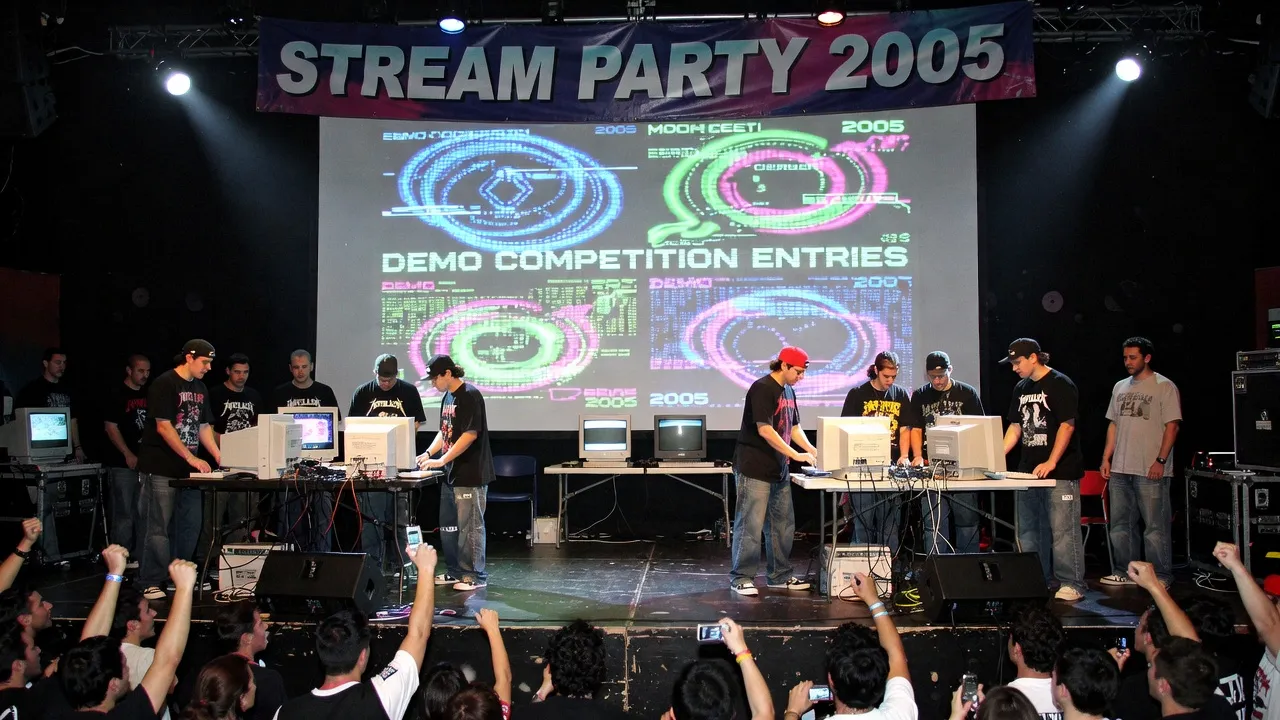
At the heart of any demoparty, large or small, are the competitions, or “compos,” where productions are unveiled and judged. Stream MEGA 2005, like its peers, would have hosted a range of compos: typically a main demo competition, various intro categories (4k, 64k), music compos (module, streaming audio), graphics compos (pixel art, photo/freestyle), and often a “wild compo” for anything that defied easy categorization. However, the spirit of these competitions at a community party like Stream MEGA differed significantly from the high-stakes environment of a larger event. Here, the emphasis shifted away from winning prestigious prizes or global recognition, and towards participation, feedback, and the sheer joy of creation.
For many attendees, simply finishing a production in time for the deadline was a victory in itself. The vibrant, supportive atmosphere encouraged experimentation and risk-taking. A debut production from a new coder, though perhaps technically rough around the edges, would be met with enthusiastic applause and constructive feedback, rather than harsh criticism. Voting, often done locally by attendees, tended to be more appreciative and encouraging, reflecting the collective desire to uplift and celebrate all efforts. The “prod” itself—the demo, intro, track, or graphic—was paramount, a testament to the creator’s skill and dedication, irrespective of its final ranking.
Stream 2005 belongs to the broader history of Finnish and European demoparties that stretches from Assembly to today’s Revision.
The feedback loop at Stream MEGA would have been immediate and personal. After the compos, groups of demosceners would gather around monitors, dissecting each production, discussing techniques, and offering advice. This wasn’t just about critique; it was about knowledge transfer, a core tenet of the demoscene. Veteran coders might walk a newcomer through a complex algorithm, graphic artists might share tips on palette management, and musicians might explain their synthesis techniques. These impromptu workshops, often stretching into the early hours of the morning, were invaluable learning experiences that simply couldn’t be replicated online.
Beyond the formal competitions, the social aspect was equally, if not more, important. Late-night coding sessions, fueled by caffeine and camaraderie, saw collaborative projects emerge from spontaneous ideas. Friendships were forged over shared frustrations with a bug or triumphs over a tricky optimization. Stream MEGA, in this sense, served as a vital proving ground. It was where new ideas were tested, new styles explored, and new talent honed before perhaps making an appearance on a larger stage like Assembly. The productions seen at Stream MEGA might have been more raw, more experimental, or simply less polished than those at the very top tier, but they were no less significant. They represented the beating heart of the scene: a culture of continuous learning, mutual support, and an unwavering passion for pushing the boundaries of what computers could do, all within a welcoming, inclusive environment.
The Culture of Small European Demoparties
The demoscene is often perceived through the lens of its largest and most spectacular events, where thousands gather and productions showcase cutting-edge technology. However, the enduring vitality of the scene owes just as much, if not more, to the network of smaller, more intimate European demoparties like Stream MEGA. These events are the lifeblood, the essential connective tissue that binds the community, nurtures new talent, and preserves the scene’s unique cultural traditions. In 2005, as the demoscene navigated the complexities of evolving hardware and the internet’s increasing influence, these grassroots gatherings were more important than ever.
One of the most significant aspects of small parties was their accessibility. Stream MEGA’s free entry for international visitors was a prime example, but even for local attendees, costs were typically minimal compared to larger festivals. This meant that students, hobbyists, and those with limited budgets could easily participate. The atmosphere was inherently less intimidating, making them ideal for beginners. A newcomer to the scene could walk into Stream MEGA and feel immediately welcome, surrounded by enthusiasts eager to share their knowledge. This nurturing environment was crucial for attracting and retaining new blood, ensuring the scene’s continuous evolution.
The musical identity of events like Stream reflects deep cultural roots — musiques-traditionnelles.com explores how music tradition and digital culture intersect.
These parties also served as vital regional hubs. While Stream MEGA was a Finnish event, its welcoming nature attracted demosceners from neighboring Nordic countries and beyond. This fostered a unique blend of local flavor and international exchange, strengthening both regional scenes and the broader European network. Unlike the often-anonymous experience of online forums or IRC channels, these parties offered direct, face-to-face interaction. This personal connection was invaluable for building lasting friendships, facilitating collaborations, and sparking new ideas through spontaneous conversations and shared experiences.
Small parties embodied the demoscene’s inherent DIY ethos. Often organized by a handful of dedicated individuals (like Matt Current/Jean Nine for Stream MEGA), they relied on volunteer effort, borrowed equipment, and a collective spirit of “making it happen.” This hands-on approach reinforced the scene’s hacker roots—the idea of taking technology into your own hands and bending it to your creative will. There was a palpable sense of shared ownership and collective responsibility for the success of the event. This culture of collaboration extended to the creative process itself; it was common to see demosceners helping each other debug code, offering artistic advice, or collaborating on a music track. This open-source spirit, long before the term became mainstream, was a hallmark of the demoscene, with tools, techniques, and even source code often shared freely.
Culturally, these smaller events were crucial for maintaining continuity and tradition. They provided a space for the scene’s unique blend of technical prowess, artistic expression, and underground sensibility to flourish, shielded from the pressures of commercialization that sometimes accompany larger events. They were places where the essence of the demoscene – the passion for pushing limits, the joy of creation, and the strength of community – could be experienced in its purest form. They were not just parties; they were cultural touchstones, vital for the ongoing health and vibrancy of the European demoscene.
Inspired by Stream? Our guide to how to attend or organize your own demoparty explains what it takes to participate.
The Stream Series: Context and Legacy
The hardware and software landscape of 2005 shaped what was possible at Stream — i-Actu’s retrospective on how technology trends shaped demo production in the 2000s provides useful context.
The Stream series, running from 2003 to 2011, played a quietly significant role in the Finnish demoscene landscape, with Stream MEGA 2005 being a prime example of its impact. Organized by dedicated individuals like Matt Current (Jean Nine), these events were born out of a perceived need for regular, accessible gatherings that could complement the annual behemoth of Assembly. While Assembly was undeniably the pinnacle for many, its sheer scale and infrequency meant there was a demand for more frequent, smaller-scale opportunities for demosceners to connect, collaborate, and showcase their work. The Stream series stepped into this gap, providing consistent meeting points throughout the year.
The mission of the Stream series was clear: to foster community, encourage creation, and provide a platform for both established and emerging talent within a relaxed, inclusive environment. Unlike the high-pressure, often competitive atmosphere of some larger parties, Stream events cultivated a more supportive vibe, making them ideal for experimentation and learning. The fact that the series ran for nearly a decade underscores its success and its importance to the Finnish demoscene ecosystem. It demonstrated the sustained dedication of organizers like Jean Nine, whose tireless efforts behind the scenes are often the unsung heroes of demoscene culture. Running a demoparty, especially on a shoestring budget typical of smaller events, requires immense personal commitment, from securing venues and equipment to coordinating volunteers and managing logistics.
The legacy of the Stream series, and Stream MEGA 2005 in particular, extends beyond the immediate experience of the attendees. These events were crucial for the continuous development of skills within the Finnish scene. They provided regular deadlines that motivated creators, informal workshops that facilitated knowledge transfer, and a stage for works that might not have been ready for Assembly’s global spotlight. Many groups and individuals who later achieved international recognition likely honed their craft and tested their ideas at events like Stream MEGA. It was at these parties that collaborations were sparked, new techniques were shared, and the next generation of demosceners found their footing.
Archival efforts, such as this article, are essential in recognizing and preserving the memory of such events. While the productions from Stream MEGA 2005 might not be as widely archived or discussed as those from larger parties, the cultural impact of the event itself is undeniable. It contributed to the rich tapestry of demoscene history, reinforcing the values of community, accessibility, and direct interaction that remain central to the scene today. Even as technology evolves and the demoscene finds new platforms and expressions, the spirit embodied by the Stream series — the passion for creative coding, the joy of sharing, and the strength of a dedicated community — continues to resonate. Stream MEGA 2005 stands as a testament to the enduring power of grassroots initiatives in shaping and sustaining a unique and vibrant subculture.